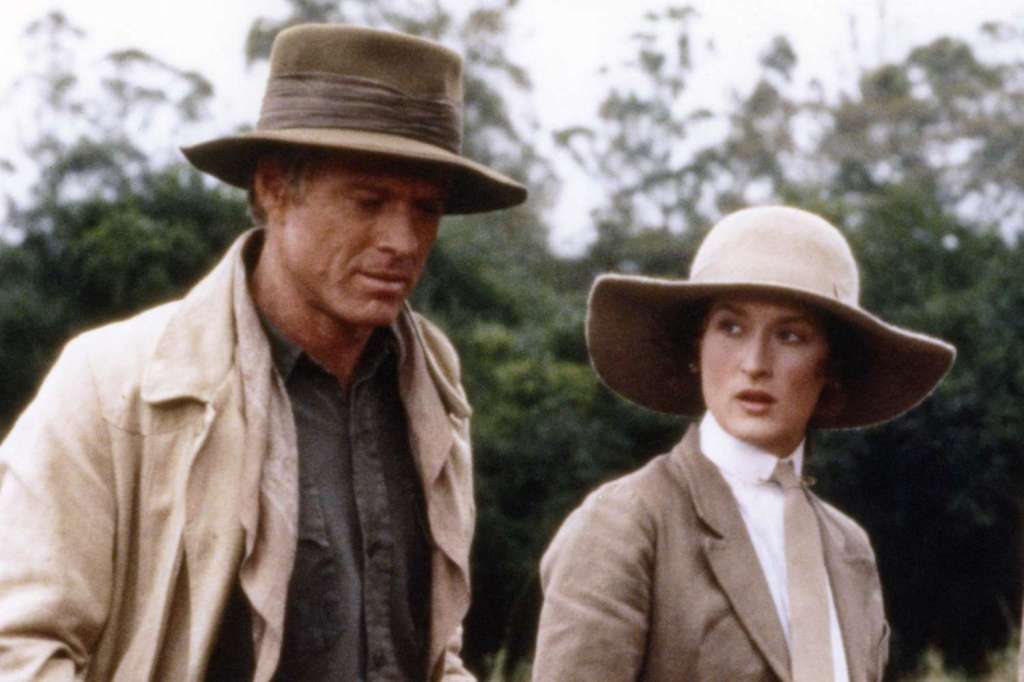
Out of Africa (1985)
Sydney Pollack’s Out of Africa and Abdulrazak Gurnah’s short story “My Mother Lived on a Farm in Africa” (2006) provide two different and polarizing portrayals of Africa under the umbrella shadow of colonialism. While Pollack’s film transforms Karen Blixen’s memoir into a lush, nostalgic romance of white settlers in Kenya, Gurnah’s narrative completely obliterates that fantasy through the everyday recollections of Munah, a woman whose daughter casually invokes Blixen’s famous line of “I had a farm in Africa” merely to expose the gulf between European settler nostalgia and actual African lived experience. By placing these works in conversation with Edward Said’s theory of imperial memory in Culture and Imperialism and Josef Gugler’s striking critique of cinematic colonialism in Out of Africa: Settler Romance in Nature Paradise, it becomes more-than-obvious how cultural texts not only sustain but also distort and contest overall imperial power. I strongly believe both of these works heavily reveal that gender is not incidental but central to understanding how colonial memory circulates, whether in the guise of European baroness or the African mother.
Pollack’s Out of Africa was certainly released to immense acclaim, winning seven Academy Awards, including Best Picture in 1986. Yet as Gugler so graciously demonstrates, its commercial success came precisely from its ability to recycle colonial nostalgia into consumable beauty for the masses. He argues that the film is “the most important recent example of the ‘beautiful Africa’ approach,” transporting audiences into somewhat of a Garden of Eden where Europeans rule naturally, native Africans exist in only the background, and the entire landscape itself seems designed for white romance (Gugler 22). Specific scenes such as Karen Blixen’s servants singing gleefully while harvesting coffee dangerously reproduce the illusion of contented subjugation (Gugler 23). The simple visual pleasure of watching Meryl Streep and Robert Redford against sweeping savanna vistas obscures the reality that this beauty rests on dispossession of Kikuyu land and African labor.
These distortions extend to characterization as a whole. Gugler points out how Hollywood deliberately diminishes African figures like Chief Kinanjui, who in Blixen’s memoir was an aristocratic leader, but in the film becomes a shuffling old man bowing submissively before a white woman (Gugler 24). Would it be such a risk to ask if we have room for surprise with the silver screen anymore? Similarly, Farah Aden, historically a multilingual Somali who handled Blixen’s accounts, is reduced to nothing more than a local servant speaking broken English. By erasing African subjectivity and agency in total, Pollack’s adaptation reinscribes what Said describes as “the hegemony of imperial ideology, which by the end of the nineteenth century had become completely embedded in the affairs of cultures whose less regrettable features we still celebrate” (Said 12). The film thus exemplifies how empire lingers in cultural memory, not as the brutality of land alienation and racial segregation, but as the romance of good old khaki, ethereal coffee farms, and sophisticated aristocratic lovers.
Gurnah’s “My Mother Lived on a Farm in Africa” directly engages with this cinematic myth. The story begins with Munah overhearing her daughter Kadi echo Blixen’s famous line after watching Out of Africa: “My Mother Lived on a Farm in Africa” (Gurnah 49). The phrase, most definitely heavy with colonial nostalgia, becomes almost absurd when applied to Munah’s actual life. Unlike Blixen’s sprawling estate, Munah’s farm was “small and paltry and human,” a place where she worked under the authority of relatives and not as a mistress surrounded by loyal servants (Gurnah 50). The contrast rips the curtain off of how the cultural memory of Africa in Western imagination, of crystal glasses, heavenly lamplit verandas, and clear, open skies, erases the daily toil of Africans themselves.
Said’s repetitive insistence that the imperial past “has entered the reality of hundreds of millions of people, where its existence as shared memory and as a highly conflictual texture of culture, ideology, and policy still exercises tremendous force” (Said 12) is directly visible in Gurnah’s story. Munah’s daughter, living in England, can only imagine her mother’s African past through the cinematic images of Blixen’s paradise. This so-called “shared memory” is extremely conflicted: for Kadi, it’s a glamorous boast; for Munah, it is a direct source of rage, deep regret, and alienation. Gurnah dramatizes Said’s argument that the true meaning of empire is not contained within the colonial period but reverberates in subsequent generations, shaping diasporic identity, the trials of mother-daughter relationships, and the struggle over representation of self.
Both Pollack’s film and Gurnah’s story pull the wool back from how women’s experiences are central to postcolonial memory. In Out of Africa, Hollywood reconfigures Karen Blixen as both independent and dependent: she defies men at the Muthaiga Club but remains as a woman needing male initiation into writing and adventure. As Gugler observes, instead of problematizing colonial domination, Out of Africa makes “gender into the salient issue” (Gugler 25). The ever-respected white woman’s hardship is foregrounded in her trek with supplies to the army camp and her struggle against a “men’s war,” while the African laborers who risked more by walking on foot remain invisible.
By contrast, Gurnah gives voice to an African woman whose memory is not of romance but difficult labor, silence, and more constraint than we could likely imagine. Munah recalls how, as a fourteen-year-old, she was sent to live on her uncle’s farm to relieve her mother’s burden. Her work included “sweeping the yard, cooking, washing clothes, and cleaning the fruit and packing it in the baskets for transport to the market” (Gurnah 52). These traditionally gendered tasks reinforce that African women were doubly marginalized: often subject to patriarchal authority within families and to colonial dispossession beyond them. The very phrase “subject people,” which Blixen romanticized, becomes too literal in Munah’s memory. She was, in fact, “the subject people, subject to life and to others, sent from here to there and back by those who loved her and owned her” (Gurnah 50). One would argue that in this sense, Gurnah heroically reclaims gender not as a diversion from race but as undoubtedly inseparable from the postcolonial condition. Munah’s bitter recognition that her daughter’s friends could only fathom or comprehend her Africa as either a colonial paradise or televisual poverty proves the persistence of imperial ideology in molding gender identity and belonging.
After absorbing and ruminating on the above works, I have ultimately arrived at the conclusion that Out of Africa and “My Mother Lived on a Farm in Africa” are fantastic examples of how cultural narratives mediate the memory of empire. Pollack’s film, with its sumptuous romance and vivid cinematography, exemplifies all of the ways Hollywood sustains colonial nostalgia by placing the spotlight on white settlers as protagonists of African history. Gurnah, writing from the perspective of the formerly colonized, topples this myth by giving voices to the silenced labor and strained lives of not just African women of that time but as a people to this day. In dialogue with Said’s insistence on the persistence of imperial memory and Gugler’s critique of Western cinematic portrayals, the real point driven home is that the past is never past. It survives as a contested visage, shaping identities across numerous generations. Moreover, they nail the moral that gender is not an aside but a key axis of postcolonial analysis, whether that be through Blixen’s privileged struggles or Munah’s marginalized labor. Women’s stories will forever illuminate the conflicted terrain where empire continues to haunt the present like the ghosts of our very own pasts.
 Static Pages, Moving Meaning
Leave a comment