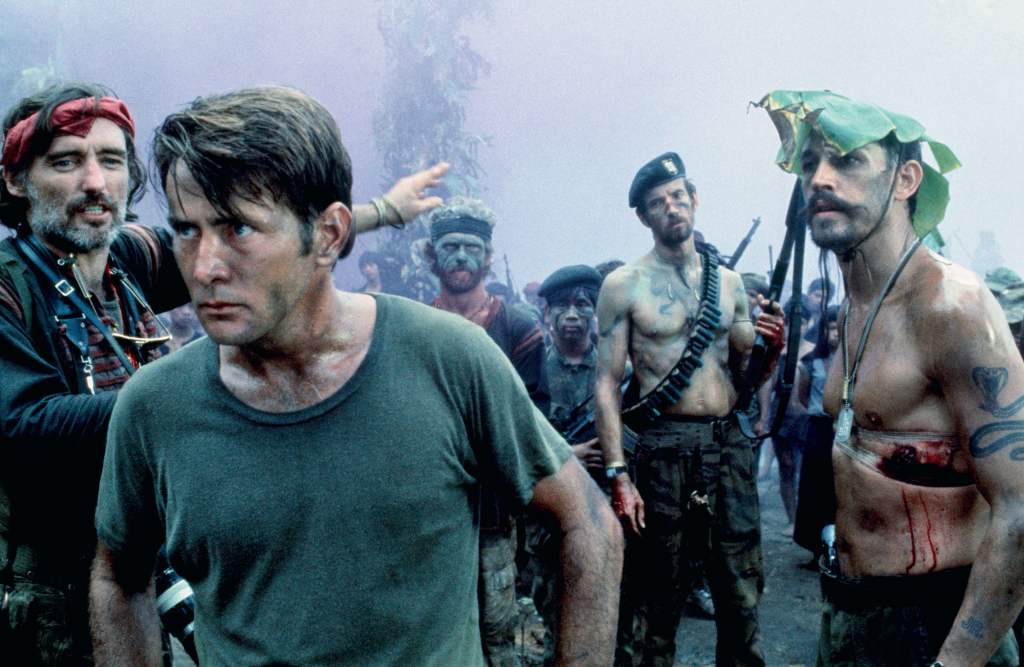
Apocalypse Now (1979)
Francis Ford Coppola’s Apocalypse Now (1979) and Joseph Conrad’s Heart of Darkness (1899) both undoubtedly chart the descent of European men into imperial spaces where conquest is framed as both inevitable and just as morally ambiguous. While Conrad embeds Marlow’s Congo journey in the rhetoric of civilization and trade, Coppola decides to displace this narrative into the Vietnam War, turning Conrad’s colonial critique into a meditation on American militarism and empire. Together, these works boldly expose the entanglement of race, gender, and overall power in imperial projects. Reading them alongside Anne McClintock’s analysis of colonial gender hierarchies in Imperial Leather and Chinua Achebe’s condemnation of Conrad’s racism blatantly reveals how narratives of empire, whether European or American, sustain themselves by denying full humanity to the colonized while obsessing over the myriad of anxieties of the colonizer.
In Heart of Darkness, Marlow insists that imperial conquest is “robbery with violence, aggravated murder on a great scale” (Conrad 21). Yet this critique coexists with passages that tend to reinforce colonial stereotypes, particularly in the dehumanizing description of Africans as a “violent babble of uncouth sounds” (Conrad 33). Achebe doesn’t miss the chance to argue famously that Conrad reduces Africa to “a metaphysical battlefield devoid of all recognizable humanity” (Achebe 783). This reduction here is not accidental but integral to the novella’s atmosphere, which depends on Africa as a backdrop for European self-reflection. The “darkness” is not only the Congo’s wilderness but also the projected fears and desires of the imperial imagination. One could argue that McClintock clarifies how Conrad’s narrative encodes nothing short of racial and gendered hierarchies. She observes that imperial ideologies often figured colonized spaces as feminized terrains, to be penetrated and possessed by masculine conquest (McClintock 23). Kurtz’s African mistress, who remains wrongfully unnamed and voiceless, epitomizes this forsaken trope. She is described as a magnificent figure but only insofar as she symbolizes Kurtz’s excesses. The novella shamefully denies her interiority, thereby reinforcing the patriarchal and racial logic that underpins empire.
Coppola’s Apocalypse Now transposes Conrad’s colonial anxieties into America’s war in Vietnam, brutally exposing how imperial logic persisted in new forms. Early in the classic film, Captain Willard is ordered to “terminate Kurtz’s command with extreme prejudice” (00:13:45), a phrase that completely sanitizes assassination with bureaucratic language, echoing the euphemisms Conrad critiques. The famous helicopter assault on a village, accompanied by Wagner’s “Ride of the Valkyries” (00:48:10), dramatizes the true spectacle that is technological domination. Yet Coppola undermines this triumphalist imagery by cutting to the terrified faces of Vietnamese civilians, ultimately foregrounding the real cost of empire. The film also visualizes what McClintock terms the “anachronistic space” of empire, where contemporary technologies coexist with archaic fantasies of domination (McClintock 40). The American soldiers bring surfing and rock music into the Vietnamese jungle, for whatever reason, collapsing time in a grotesque parody of leisure and war. In this diegetic sense, Coppola insists that Vietnam was not a break from but a continuation of colonial violence. An imperial project repackaged as Cold War intervention, if you must.
Now, Achebe’s essay compels us to ask whether Apocalypse Now escapes the racist structures that mar Conrad’s novella. Coppola gives Vietnamese and Cambodian characters so little narrative voice, often trying to frame them as anonymous victims or foes. For instance, during the river journey, the crew massacres civilians on a sampan after a woman moves toward a basket (01:20:12). The true horror lies in the Americans’ overreaction, yet the Vietnamese remain voiceless, reduced to mere props in the Americans’ moral crisis. As Achebe warns, this perpetuates the same dynamic in which Africa, or here in South Asia, serves as “a foil to Europe, a place of negations” (Achebe 783). Still, Coppola has to go and complicate this dynamic even more than Conrad. Kurtz’s compound, adorned with severed heads (02:22:05), indicts not the Vietnamese but the American war machine itself. Willard’s final cathartic act of killing Kurtz while natives perform ritual sacrifice (02:30:40) strongly suggests that empire consumes itself, collapsing under the weight of its contradictions like Itachi’s Amaterasu. Unlike Conrad’s text, which leaves Marlow complicit in lying to Kurtz’s Intended, Coppola forcefeeds viewers the barbarity of Western power unmasked.
Both works also place the relationship between empire and gender into the hotseat. Conrad contrasts Kurtz’s African mistress with his fiancée in Brussels, the “Intended,” who embodies European domestic purity (Conrad 69). McClintock reiterates how such contrasts reproduce the same stale fantasy: the African woman as dangerous excess, the European woman as a guarantor of order (McClintock 32). Coppola does more than retain this gendered divide, though with fewer women. The Playboy Bunny scene (01:10:25), in which American soldiers ogle female performers flown into the jungle, again, for whatever reason, makes explicit how imperialism commodifies women’s bodies alongside conquered territories. Women in both narratives are not full participants but symbols through which male characters negotiate their anxieties about power and control.
All in all, Heart of Darkness and Apocalypse Now successfully demonstrate how imperialism survives as both chaotic ideology and aesthetic form. Conrad’s novella couches its critique of empire in language that nonetheless dehumanizes Africans as short of people, a contradiction Achebe rightfully condemns. Coppola adapts this narrative to Vietnam, still preserving some of its racist structures but also turning empire’s violence back onto the imperial center, spotlighting America’s descent into inevitable madness. When read with McClintock’s theory of colonial desire and Achebe’s searing tongue lashing, both works prove that the “darkness” of empire lies not in colonized peoples but heavily in the systems that will always seem to exploit them. By staging conquest as both intoxicating and destructive, the more these texts will compel us to confront the enduring entanglement of race, gender, and raw violence in the legacies of imperial power.
References
Achebe, Chinua. “An Image of Africa: Racism in Conrad’s Heart of Darkness.” Postcolonial criticism. Routledge, 2014. 112-125.
Bloom, Harold, ed. Joseph Conrad’s Heart of darkness. Infobase Publishing, 2008.
Coppola, Francis Ford, director. Apocalypse Now. Performances by Marlon Brando, Martin Sheen, and Robert Duvall, United Artists, 1979.
McClintock, Anne. Imperial leather: Race, gender, and sexuality in the colonial contest. Routledge, 2013.
 Static Pages, Moving Meaning
Leave a comment