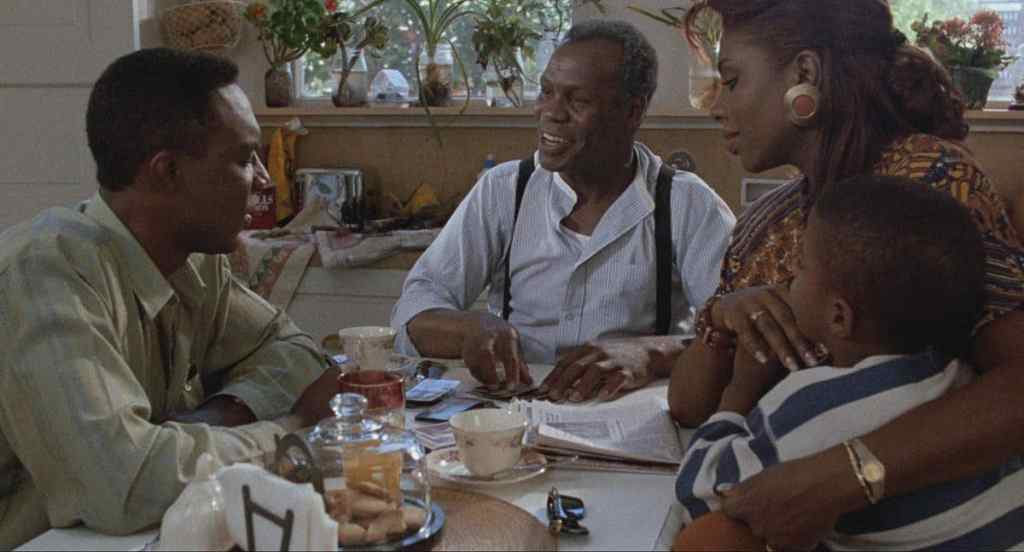
A Dry White Season (1989)
Doris Lessing’s The Old Chief Mshlanga (1951) and Euzhan Palcy’s A Dry White Season (1989) are separated by both form and medium, but they do share a main concern of how white protagonists end up confronting their implication in systems of racial domination. Both works successfully expose the hard-headed structures of settler colonialism and apartheid, yet they do so in audacious ways that mediate African voices through white characters’ crises of conscience. J.M. Coetzee’s Introduction to White Writing: On the Culture of Letters in South Africa offers a blueprint for examining this very tension, especially within his argument that settler writing frequently imagined the African landscape as either an empty “anti-Garden” or a silent space where Black labor was deliberately occluded (Coetzee 4, 6). When read alongside Coetzee’s enlightening insights, Lessing and Palcy reveal both the persistence of colonial myths of land and the difficulty of narrating African presence outside the settler gaze.
Lessing’s short story takes us on a journey following a young white girl raised on a Rhodesian farm who eventually comes to recognize the dispossession of Africans. Early in the story, Her initial perception of the African landscape is deeply molded by stodgy settler ideology. “Her books held tales of alien fairies… The black people on the farms were as remote as the trees and the rocks” (Lessing 48). This loudly echoes Coetzee’s description of South African pastoral writing, where black labor must remain invisible in order to sustain the ethereal myth of white cultivation (Coetzee 6). It is no secret that the child sees Africans as an extension of the land instead of as individuals with autonomy and interpersonal relationships, reflecting the way colonial discourse collapses people into place. Her encounter with the Old Chief unsettles this perception, finally. When she meets him on the path, she recognizes in his bearing that he’s “wearing dignity like an inherited garment” (Lessing 50). This marks a shift where the African presence is no longer background but embodied authority. Yet the story does continue to mediate his significance through her rapidly-changing point of view, never fully granting him an extended voice. The Chief’s eventual displacement confirms the limits of her awakening. “Some time later we heard that Chief Mshlanga and his people had been moved two hundred miles east, to a proper Native Reserve” (Lessing 57). His history is narrated through her realization and not his personal testimony. Lessing’s story thus both critiques and reproduces what Coetzee calls the “continued apprehension of silence (by the poet) or blankness (by the painter)” built into the settler pastoral (Coetzee 9).
Palcy’s A Dry White Season explores extremely similar dynamics within apartheid South Africa. The protagonist, Ben du Toit, begins as a teacher who accepts the system unquestioningly, reciting to his colleagues his dead-set beliefs and following all of the books. His overall worldview then begins to unravel when his gardener, Gordon, loses his son to police violence, which is a travesty we are familiar with even today. Like Lessing’s girl, Ben experiences a crisis of conscience that will then drive the rest of the narrative forward. Unlike Lessing, however, Palcy refuses to leave African suffering in the background. She confronts viewers with the physical reality of apartheid brutality. She has no qualms confronting viewers with the physical reality of apartheid brutality by showing Gordon’s body after his death in detention and Emily’s wordless grief as Ben records testimony. It does more than convey mere pain and dignity. These moments, for example, aid in disrupting the silence that Coetzee identifies as typical of settler forms, insisting on African voices as agents of critique. Still, I’ve found the film to retain rigid structure of white mediation. The arc culminates not in Gordon’s resistance but in Ben’s eventual murder as well, positioning the downfall of a white liberal as the prominent tragedy. While Palcy gives African characters more voice than Lessing, narrative authority continues to pass through the conscience of the settler. In that sense, should we be grateful for having been thrown that bone?
In both works, land manages to emerge as the contested symbol of age-old colonial ideology. Lessing shows how settler families naturalize their possession, meaning the farm is assumed to belong to the girl’s parents, even when locals insist on ancestral claims. The Native commissioner and police enforce these hierarchies, displacing the Chief and his people (Lessing 57). Coetzee describes this as the “double right” of colonial logic, where the labor of clearing and cultivating land is imagined as superior to the indigenous use of it (Coetzee 3). In A Dry White Season, the divisions of land are more urban. White families enjoy the luxuries of comfortable homes and schools, while black families are relegated to impoverished townships. These landscapes inherently make visible the economic and spatial monoliths of apartheid. Both protagonists are implicated in these monoliths but also experience the consequential distortions. The girl in Lessing’s story is shaped by the prejudices of her upbringing, which may not be any fault of her own, only later recognizing how it blinded her to others and their perspectives. Ben profits from apartheid’s privileges, but once he crosses the line of resistance, he too becomes a tragic victim of the same state violence that destroys black families. Coetzee’s argument that white writing often dramatizes white alienation while pushing Black experience to the margins resonates here more than ever. Both texts undoubtedly emphasize settler conscience at the immediate site of crisis.
The most pressing inquiry raised by these works is how African voices are represented at the crux of it, or withheld, for that matter. In Lessing, Chief Mshlanga remains dignified in all his glory but still silent, or silenced. His story is not told from his perspective and supported by his lived experiences but through the girl’s belated recognition. In Palcy, Gordon and Emily articulate their grief and resistance, but their power is still diluted through the filtering of Ben’s gradual enlightening. Both Lessing and Palcy try their hardest to resist these visions by insisting on African presence, but neither fully extricates themselves from the gravitational pull of settler mediation. Lessing’s The Old Chief Mshlanga and Palcy’s A Dry White Season do expose the violence of colonial and apartheid systems at the end of the day, while uncovering the narrative difficulties of representing African subjectivity within forms crafted by classic settler traditions. Coetzee’s White Writing allows us to witness how myths of land and silence become the support beams of both works. Lessing wedges the colonial pastoral yet mutes crucial African voices, while Palcy foregrounds apartheid brutality, although through a white protagonist’s transformation. Together, both of these works drive home the moral that dismantling colonial imagery requires not only boldly exposing injustice but completely reevaluating narrative authority itself, granting every African character full subjectivity beyond the jury of white conscience.
References
Coetzee, John M., and Louise Shabat Bethlehem. “White writing: On the culture of letters in South Africa.” (1990).
Lessing, Doris. The Old Chief Mshlanga. HarperCollins UK, 2013.
Palcy, Euzhan. A Dry White Season. MGM/UA, 1989. Film.
 Static Pages, Moving Meaning
Leave a comment