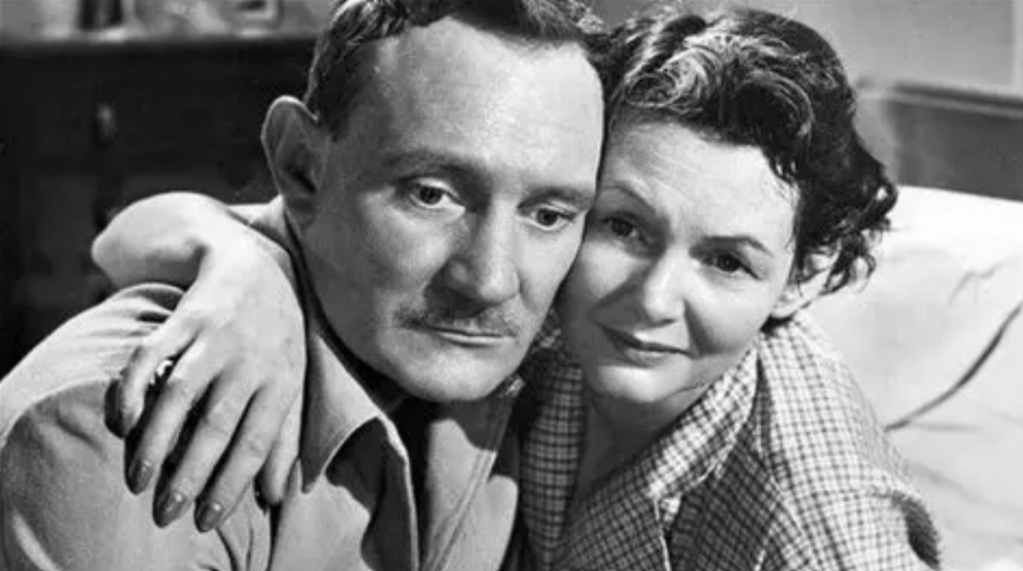
The Heart of the Matter (1953)
Graham Greene’s works never fail to stage moral crises within colonial settings, where personal decisions reflect broader tensions about imperial decline. In The Heart of the Matter (1953, dir. George More O’Ferrall) and the first half of The Quiet American (1955), the messy entanglement of private lives with political and colonial structures does more than reveal the instability of moral authority under the looming cloud of empire. Jonathan Nashel’s essay on Edward Lansdale, the American intelligence officer who inspired elements of Greene’s Alden Pyle, further illuminates how Greene took a jab at both British and American imperial logics by embedding them within fragile but relatable human dramas.
The film, The Heart of the Matter, through an adaptation of Greene’s 1948 novel, powerfully visualizes the corrosive weight of good old moral responsibility. Trevor Howard’s portrayal of Scobie is undoubtedly marked by restraint but also weariness, with his gaunt face framed in shadows that mirror his growing despair. The camera often lingers on his stoic silence in multiple scenes, signaling his paralysis between his duty and his underlying compassion. His private guilt over and affair with Helen Rolt is never purely personal but actually entwined with his symbolic role as a colonial officer. He falls victim to becoming the moral conscience of a corrupt system that simply cannot reconcile Christian ethics with imperial violence. Later on in the film, when Scobie recites the Act of Contrition before his suicide, Howard’s subdued delivery further proves the tragic possibility of reconciling faith and love in the midst of duty within the contradictions of empire. I believe the film to be a reflection of Greene’s belief that moral failure under colonialism is not individual weakness alone but the product of a greater systemic corruption claiming souls left and right.
Now, if Scobie embodies the inevitable collapse of moral certainty, Fowler in The Quiet American dramatizes the deliberate choice of detachment. Fowler plainly insists that he is to be ruled out because he is “not involved” (Greene 27), attempting to cordon off his private life with Phuong from the violent realities of French and American intervention. However, the very narrative structure undermines this stance. Fowler recounts the story retrospectively, after Pyle’s death, which casts his ironic detachment as both unreliable and extremely self-justifying. Phuong, though rendered with somewhat of a limited interiority, embodies the convergence of private desire and political power. Pyle sees her as the symbol of a future Vietnam, free from both colonial France and communism in general. Fowler, in contrast, sees her as an anchor to Saigon, “the hiss of steam, the clink of a cup” (Greene 5). She was essentially the domestic counterweight to political chaos. Despite both men objectifying her, denying her a full autonomous voice, Greene thus critiques perfectly how imperial ideology infiltrates even the most intimate relationships. Pyle’s moral absolutism, guided by York Harding’s theories, makes him inherently dangerous precisely because of his innocence. In an early conversation, Pyle insists that “what the East needed was a Third Force” (Greene 23), echoing Lansdale’s classic modernization schemes. Fowler registers the fanatic gleam in Pyle’s eyes and recognizes the peril that lies within abstract certainties. Where Scobie is paralyzed by conscience, Pyle is propelled by conviction, but both can be equally as destructive.
Jonathan Nashel clarifies how Greene’s overall characterization of Pyle was shaped by his awareness of American figures like Edward Lansdale. Lansdale’s insistence on this “Third Force” and belief that American ingenuity could engineer democratic modernity in Asia directly parallels Pyle’s reverent reliance on Harding’s theories. Nashel explains that the idea of a “Third Force” was not Greene’s invention but a concept actively promoted by Americans like Lansdale. Pyle’s advocacy of this “Third Force,” both in his conversations with Fowler and through his supplying of explosives to General Thé, closely mirrors Lansdale’s real-life attempts to bolster Thé’s political and military standing. Nashel notes that newly declassified documents confirm Lansdale was simultaneously pushing the “Third Force” in high-level U.S. discussions (Nashel 315-316). He then goes on to connect this to the ideology of modernization theory, widely promoted in American universities and applied to Southeast Asia. Greene depicts Pyle as the face of these abstract theories, which Nashel argues “weakened and corrupted” Vietnam’s political system and made it increasingly dependent on American power. In Greene’s novel, this uncritical faith in modernization is one of the main reasons Pyle ends up killed “at long range” (Nashel 316-317). In Nashel’s candid reading, Greene is meting out literary justice against those who blindly espouse Third Force/modernization theories without much regard at all for human consequences.
Greene’s use of modernist techniques in The Quiet American intensifies the recurring trend of moral ambiguity. The nonlinear narration that opens with Pyle’s death before circling back to earlier encounters casts the entire plot as retrospective justification. Fowler’s voice is both intimate and unreliable, which isn’t a surprise, forcing us to question whether or not his detachment masks complicity. As he admits after Pyle’s murder, “Everything was important to Pyle,” (Greene 15), yet Fowler avoids confessing his own role in ultimately facilitating Pyle’s downfall. This narrative distance is an intriguing peek into British society in the 1950s, painting it as a nation grappling with the erosion of its imperial identity. On that note, cinematically, The Heart of the Matter achieves a similar effect through mise-en-scène alone. The repeated use of claustrophobic interiors such as Scobie in his dimly lit office or kneeling at his bedside does wonders to create a visual grammar of entrapment. Just as Greene’s prose layers irony and distance, the film visually renders the inescapability of colonial structure that draws individuals into webs of duty and betrayal.
References
Greene, Graham. The Quiet American. Penguin, 1996.
Nashel, Jonathan D. Edward Lansdale and the American attempt to remake Southeast Asia, 1945-1965. Rutgers The State University of New Jersey, School of Graduate Studies, 1994.
The Heart of the Matter (film), directed by George More O’Ferrall, London Films, 1953.
 Static Pages, Moving Meaning
Leave a comment